A six-year-old, I sat next to my father on a seawall on the bank of the Potomac River. My chubby legs kicked against the stone warmed by the sun. I held a fishing rod indifferently, more interested in the gulls swooping down on a discarded bag from someone’s lunch drifting on the current. My line, threading into the murky Potomac, began to twitch. “Marshall! You’ve got a fish!” What, huh? I got up, ran backwards, and launched an obliging catfish into the air, over the seawall and onto the grass. I pounced.
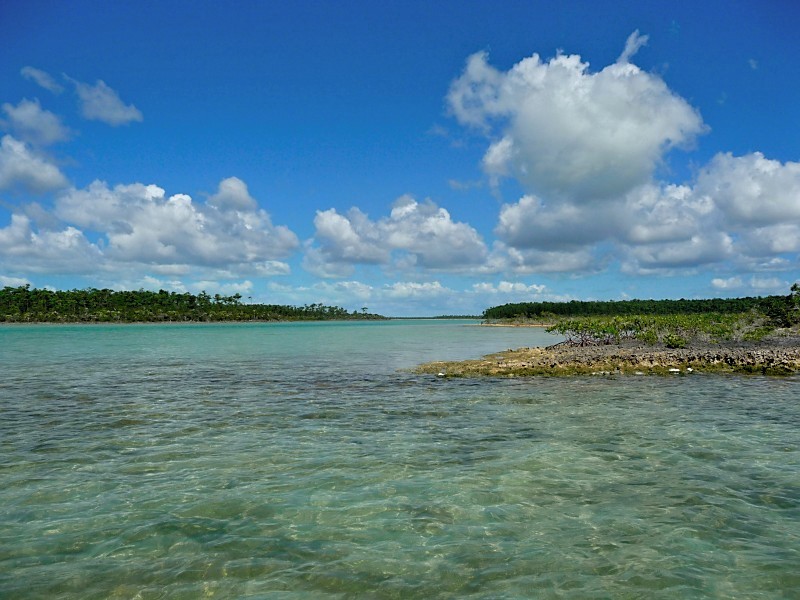
Seventy-five years later, I landed on a rough concrete runway on Andros Island, the Bahamas. My father, who went to the fishing lodge in the sky after service in the Army, has been replaced by five pals. They were my son, former IT whiz, now dog-walker; a physician who writes suspense novels (Dead in 3, available on Amazon); a real-estate maven who rescues poodles; an entrepreneur who speaks Portuguese; and a financial advisor who is a connoisseur of aged rum. At eighty-one, the catfish conqueror was the oldest of the group. Instead of a pair of khaki shorts, a T-shirt and Keds, I wore saltwater finery: Orvis pants, a cool belt with bonefish stitching, and a tropic-weight, sun-blocking fishing shirt. Oakley shades dangled on my chest. In my tackle bag, tucked in the nose of the airplane, I had gear costing as much as my first paycheck.
I was far from the Potomac River.
The San Andros Airport airstrip was marginally upgraded from the ones I landed on when I first flew to Andros. Twenty-five years ago, drug runner airplanes were abandoned next to airstrips, nose down, a metallic crop growing out of the mangroves. There were tired-looking aircraft, way beyond their Use By date, squatting on the terminal pad. It is the way of the Bahamas; aircraft, vehicles, and appliances die and rust in place. The customs people and baggage handlers were friendly and obliging, as always. When the customs agent asked the group if any of us were carrying alcohol, we looked at each other, back at her. Six hands slowly raised.
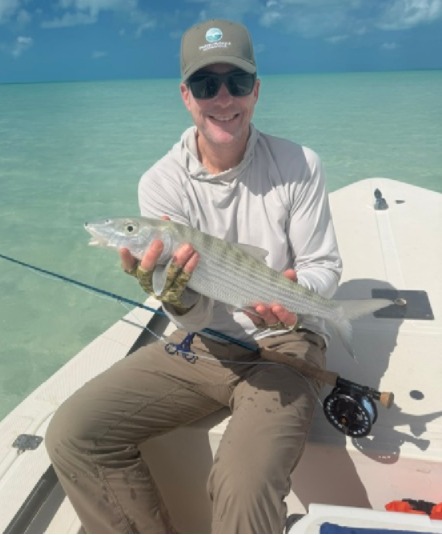
We were on Andros Island to fish for the grey ghost of the flats, bonefish. One of the fastest fish in the ocean, it is roughly the shape of a slim bullet, broad at the shoulders, tapering to the rear with a forked tail for an engine. Singly, or in twos and threes or occasionally a school, bonefish cruise for crabs, shrimp and other crustacean delicatessen.
Stanley McChrystal, renowned General of the Iraq War and expert on insurgent conflict, introduced the elegant phrase “asymmetrical warfare.” This means a bearded, turbaned type with a rocket launcher can defy a modern army with all military art at its disposal. Just so, on the Andros flats, a creature with a brain the size of a pencil eraser can easily defeat six determined fly fishermen.
There were many strikes against us as we began our adventure. We were fly fishermen, choosing a difficult, old-school, way to catch fish. We are talking 15th century old-school, when Dame Juliana Berners wrote the first book on fishing, A Treatyse of Fysshynge wyth an Angle. We may not fish much differently now than she did, but we spell better. Fly fishing for bonefish requires passion for the quest like Captain Ahab in Moby Dick, requires perseverance like Santiago in The Old Man and the Sea, and requires the artistry of Paul MacLean’s casts in A River Runs Through It.
On this trip, I stepped on the line pooled at my feet. The fly line wrapped around my reel handle. I caught the fly on my pants. I did not tie the fly on the line securely and the fish hightailed it. Thankfully there were no Doctor Flies, the scourge of the Bahamas, who insert their blood-sucking snouts into our ankles, raising itchy welts.
Weather sneered at us, offering wind and clouds. Casting a fly into the wind is a Sisyphean task. Standing knee deep on a flat, I cast at a bonefish munching thirty feet away, but repeatedly dropped the fly too short. If there were clouds or an overcast day, we could not see the fish. Might as well go back to the lodge and knock off the remainder of the Glenfiddich.
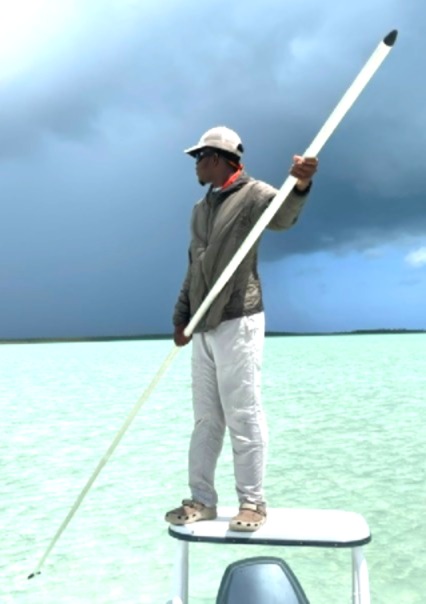
The bonefish guides loomed over everything. Standing high above the flats boat deck on a platform, push pole in hand, the guide is an imperial figure. He conducts the performance, runs the show. Guides can be more demanding than my 10th grade English teacher, Mr. Boyle, who had us write our grammatical errors on the back of our composition 15 times (dangling participles were my specialty). Guides can be more tyrannical than my platoon NCO, Sergeant Rodriguez. Guides can be more critical than My Life’s Editor when I hand over my first draft of a post.
You think, “You people are masochists. Why even get out of the airplane? Avoid abuse, go back home, take up embroidery.”
It was about the moment the guide spotted a fish moving down the shoreline towards the boat. He whispered, “Fish, at 11:00, fifty feet.” Old eyes that are fine for spotting yoga pants in downtown St. Pete, strain to pick up the oncoming bonefish. “Wait, wait,” said the voice from above, then, “Cast, cast!” I false cast once, twice. “Drop it, drop it!” he urged. I did.
The fish darted toward the fly, took it and exploded in an initial burst of speed, a run covering half a football field in about four seconds. Husain Bolt would be left in the dust. I held the rod tip high as line evaporated from my reel.
When the bonefish finally came to hand, I was grateful to it, to the guide, to this beautiful place. I offered a benediction and gently released the bone with a sore lip. He would have a story to take home to his fry.
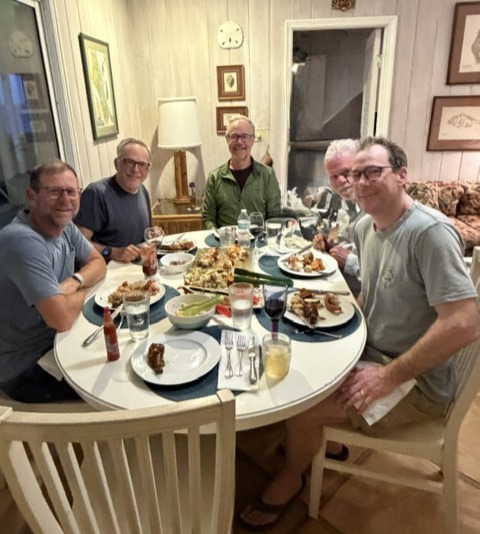
For several days the six of us were caught in a Bermuda Triangle between the guides’ scrutiny, windy weather and picky fish – times that try men’s souls. At day’s end, we gathered to break bread and share a bottle of wine. We licked our wounds, some physical, some mental, and told unverifiable stories, graced by laughter. Good times for “We few, we happy few, we band of brothers.”


Well done. Do you think all the guides go to the same school? Seems like my guide in Belize 20 years ago had the same teacher, at least for the abuse part. Hope you guys are well.
Tom
LikeLike