
“We have never been a melting pot. The fact is we are more like a tossed salad. We are green some of us are oil, and there’s a little vinegar injected when you get up to Ottowa.” Arnold Edinborough
“When I’m in Canada, I feel this is what the world should be like.” Jane Fonda
The Philadelphia airport security control was loud with people slamming plastic bins crammed with their carry-ons down onto the conveyor belt. The maw of the X-ray machine gaped ahead. Human cattle shuffled past TSA apparatchiks wearing symbols of authority. “Look up at the camera!” “Move on!” “Next!” Next!” I trudged along with the rest of my fellow cattle, passing through the metal detector. Thankfully, I did not get wanded, betrayed by a tube of ChapStick, as has been the case in the past. I also did not have to insert myself into the giant plastic scanning tube where I must fit my feet into the outlined shoes and raise my hands in under-arrest mode, possibly exposing something illegal wedged between my personal parts. Elated at having cheated death again, I retrieved my goods from the other end of the belt and rejoined My Life’s Editor. We headed for the gate for our Tampa- bound flight.
A scant 24 hours ago, we had been in a foreign country, although it is difficult to call Nova Scotia a “foreign country.” The province of Nova Scotia is an almost-island that hangs onto the mainland via an umbilical cord to New Brunswick. Unlike the TSA operation at the Philadelphia airport, where love was a scarce commodity, in Canada we had felt the love. Wherever we went, our statement that we were from Florida, USA, was greeted by a compassionate smile that meant, “Oh, you poor thing,” as if we had contracted an untreatable disease.
We started in Halifax. It is one of the largest ice-free natural harbors in the world and was the port where Titanic victims and survivors were taken in 1912. It is also the place where the French cargo ship SS Mont-Blanc, laden with munitions, exploded in 1917 with a force only exceeded by the first nuclear bomb. Halifax has hills, a topographic feature with which herself and I, who live on a sand bar separating the U.S. from Cuba, are not familiar. Within two days, our calves and quads were protesting.
We noticed, as we scoped out the city, that the population looked like the United Nations. A trip to the Immigration Museum revealed that Canada opened its doors to the rest of the world but was practical about it. You could not enter unless you had a verified job or resources, carried no disease, and were not a criminal, any of which might bar some of our politicians. Like in the U.S., enthusiasm for immigrants has alternately waxed and waned. Today 23% of the Canadian population is made up of immigrants, compared to 16% for the U.S. The ICE folks are diligently working to reduce the last number.
Nova Scotia is rueful about its treatment of Acadians, French Roman Catholics who colonized the north shore in the 17th century. Peaceful, farming folks, they were whacked by one side and then the other like a badminton bird as the French and British Empire vied for Acadian turf. The Brits, the last empire standing, expelled them violently in the Grande Dérangement. Many Acadians went to Louisiana where they introduced Zydeco, bread pudding, and crawfish étouffée.
Nova Scotians sound like us and, unlike their Brit cousins, drive on the proper side of the road. They do not drive like us. They do not drive like their hair is on fire, viewing any opening in traffic as a challenge. The left lane is for passing only. Really. On a major highway, a car would come up behind us, pull calmly into the outside lane, pass us and then slide back into our lane, accelerating away. In the U.S., the passing lane is your natural right, a sixth freedom. Leaving it would amount to surrendering your manhood. Pete Hegseth would have the entire country tested for low T.
We stopped at a two-pump petrol station plopped on a hillside, surrounded by the everlasting Nova Scotian forest. I saw a fellow petrolling up next to us. I got out, studying the pump. Where do I insert or wave my credit card? “Can I help you?” he asked. He was there to fill up my car! I went into the station to use the loo. Two old, wrinkled types in union suits, wearing wellies, sat on chairs playing cribbage, the board set on an upside-down can.
Canadians use the metric system and the Celsius scale, systems used by most of the world. It would seem logical that the U.S. would, too. After an attempt to educate the masses, the last US committee to promote metrics vanished in 1982. Kilometers were erased from our highway signs. Americans fear metric adaptation because it will lead to socialism, 30-hour workweeks, and latte breaks.
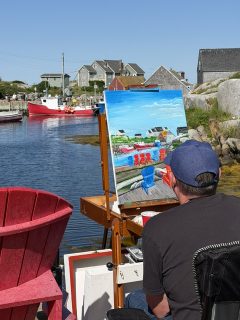
We visited Peggy’s Cove, a UNESCO World Heritage Site. It is tourist-intensive, with buses disgorging badly dressed people who come to see massive rocks on a wave-tossed shoreline, with a pristine white lighthouse, and a working fishing village, replete with nets, floats, and colorful wood houses. Visitors were quiet as they scrambled over the boulders, respectful of the plein air painters scattered about with their easels. We craned our necks, peering over their shoulders, checking out their work.
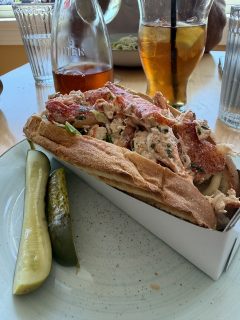
We discovered the Annapolis Valley in mid-Nova Scotia has vineyards. Maybe beaver pelts, Hudson Bay blankets, and hockey players, but Canadian white wine? I recommend Tidal Bay, Nova Scotia’s first official wine appellation. Try it with a lobster roll or fresh scallops on a bed of risotto. Yum.
Another regional specialty is poutine. Originally a fixture of Quebec cuisine, it consists of a limp mound of French fries drenched in mucilaginous gravy with a sprinkle of cheese curds. I would not blow a glass of Tidal Bay white on a bowl of it. Maybe try an aperitif – Pepto Bismol lightly chilled.

Beyond the sheer beauty of the Cabot Trail around the Cape Breton National Park and the inlets with charm-intensive lobster fishing villages, My Life’s Editor and I were struck by the neat, modest houses along the two-lane roads. Each trimmed lawn featured a salt box at the end of the driveway, reminding us of the possibility of winter. The Canadian flag hung at every other home; clumps of day lilies lined the roads and groupings of brightly painted Adirondak chairs appeared like mushrooms after a spring rain.
At times, travelling across the province, we felt we were living in Bedford Falls of “It’s a Wonderful Life.” George Bailey checked us in at the hotel desk. Clarence the Angel took our order at dinner and Uncle Billy was behind the counter at the pharmacy. Nova Scotia was not flashy, not presumptuous. It was good for our souls. I have decided to memorize “O Canada” for the next Rays-Blue Jays ball game.
A sign in front of a white clapboard restaurant on the way to Peggy’s Cove said it all:
“Beer, Lobster ….. Enough Said”

