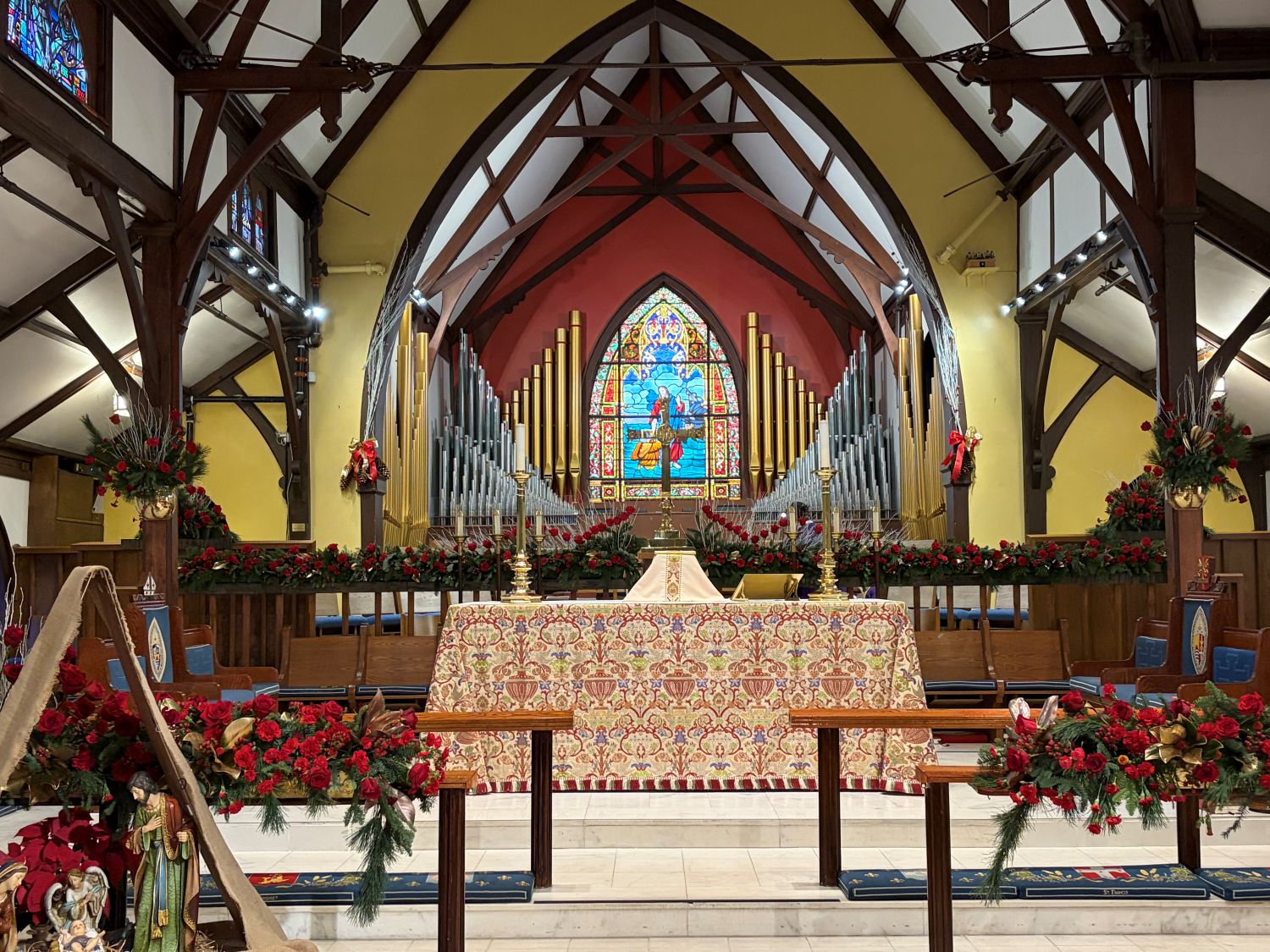
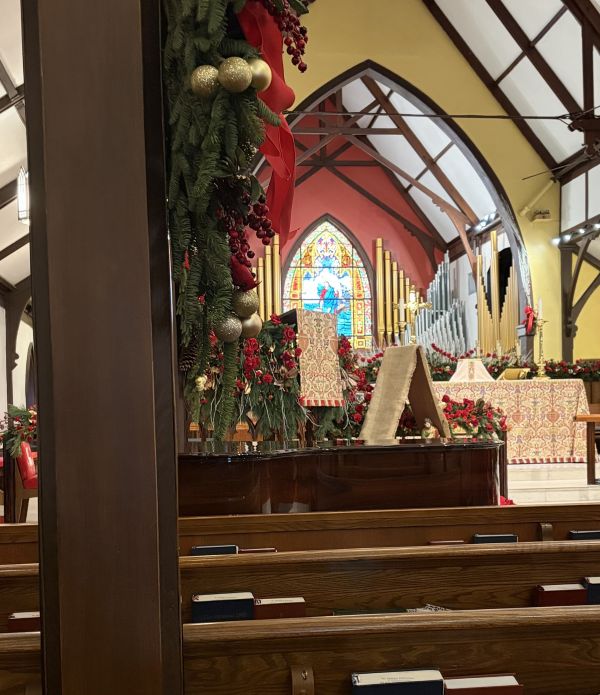
Christmas Day, I sought out my pew at St. Peter’s. An Episcopalian from the cradle, I am into pomp and circumstance. My church is a swell affair, being the Diocese Cathedral. Wooden vaults reach up, supporting the ceiling at nosebleed height. The vaults stand on wooden pillars. Sundays, I sit next to one of those pillars, on the left hand, or Gospel side as you face the altar. A problem with my seat is that the pulpit from whence sermons come is on the same side. If I find myself dozing off mid sermon, missing all the good stuff about sin and redemption, I must skooch over slightly, to position my head behind the pillar, out of the minister’s line of sight. My fellow pew-mates are attentive to the opining cleric; they do not notice my eyes are closed. This works until I enter the full open mouth mode, snort, and wake myself up. I look around accusingly. Hey, who did that?
Years ago, at ROTC summer camp, there was nothing to hide behind. My company was sitting in bleachers in an open field at Ft. Devens, MA. We had just eaten lunch in the mess hall, and the sun was pounding down on our steel pots. Sergeant Rodriguez, uniform starched, sporting a slick black moustache, was addressing us on the fascinating attributes of the 60mm mortar. Heads nodded. I nodded. The sergeant got my attention by applying the business end of his baton to my helmet. I took the front leaning rest position and gave him 50 pushups. Later in the day, I hit the dirt for 50 more after saluting our Captain with a cigarette in my mouth.
St. Peter’s Sunday service involves a verger. He carries a stick, called a verge, dresses in a brown clerical duster and proceeds the clergy, in and out. In medieval times the verger served as the “protector of the procession,” ready to calm things down should the congregation get rowdy. Back then he would have carried a mace with a serious club at the business end. I am reasonably certain our verger will not come down and whack me with his staff if I am caught snoozing. It is a risk I am willing to take.
Church services are not without disruption, particularly in a city’s downtown. One cold winter’s day, one of our fair city’s street people wandered in to get out of the cold and sleep off his beverage of choice. He entered the nave as the clergy, altar boys, and chorus – the whole shebang- gathered behind him in the atrium. Being good Christians and non-discriminatory, the ushers handed him a program and welcomed him in. He weaved uncertainly up the center aisle, stopping occasionally to scratch. He could not decide where to plant himself. Parishioners drew back as his bodily essence wafted their way.
The organist pounced on his keyboard and the processional hymn began. The street dude flinched at the first note and looked back, goggle-eyed. A robed phalanx advanced on him from behind. They sang as they herded him up the center aisle towards the altar. A hand reached out from the congregation and snagged him in before he could make his way to the communion wine.
I have avoided sitting on the Epistle side of the church because there is a large painting of a Madonna and Child on a side wall that gives me the willies. The Madonna is dressed in robes, strong as a Russian shot-putter. She sits in a chair, one foot planted in front of the other like an Egyptian statue. Her face exhibits dark Balkan features with an implacable, stern expression. She holds the baby Jesus in her left hand, tucked against her chest like the football in the Heisman trophy. The baby Jesus and the Madonna have halos. I call her The Madonna of Fullbacks.
Long-established church parishioners claim squatters’ rights on their particular stretch of pew. They are territorial. If a stranger has planted his bum on their Sunday planking, they give him the Christian skunk eye as they squeeze by him into an unaccustomed space. Colonial churches in New England had enclosed pews. If a stranger had tried to unlock the latch and enter, a family might have hailed the verger to repel him.
Episcopalians like their boundaries. They are circumspect, not given to rising up in the pews and coming to Jesus publicly, speaking in voices. The closest we get is the Peace, where we are blessed by the minister, then stand and howdy each other. It is like the “Five and Ten Rule” of customer service in the hospitality industry. Within five feet, you reach out and give the handshake of peace, unless you are a couple and may smooch. Up to ten feet away, a smile and Queen Elizabeth wave do the trick. The minister has no such boundaries. As if running for office, he comes down from the altar and passes out vigorous two-handed grasps to folks in the first several rows, whether they have pledged or not.
We do like to sing with gusto and have 700 hymns, most of which were written before electricity was invented. Since my range is limited to an octave and a half, I let the higher notes go. I leave them to the lady behind me, who is heavily into tremolo. Our blue hymnal, weighty with so many hymns, could make a good doorstop. When the organist cranks up and 300 parishioners simultaneously pull their hymnals out of the wooden pew racks, there is a shlupping noise like a herd of wildebeests crashing through underbrush. This is only matched by the crackling noises of 300 program pages turning during a reading.

I was once a big cheese at the Cathedral. These days I see new faces stand up at the annual meeting and take their turn at the dais in the assembly hall. I shake the hand of somebody who does not know me, and he asks how long I have been at the church. I think: “I used to be a somebody.” I am now a FIP, a Formerly Important Person. As I wistfully recall my past glory, there comes a vision of me at the lectern on a Sunday in November at the retiree-intensive 8:00 AM service. I am spiffy in my tie and coat. I explain to the congregation that it is time to get their annual pledges in. Their stony faces remind me of Grant Wood’s American Gothic, sans pitchfork. I am going to lose the “Most Popular Guy on Campus” vote. Do I need more glory?
Nah.
 Marshall Craig
Marshall: Very funny. Merry Christmas to you and Diana. We are looking forward to Sarasota in February.
Tom
LikeLike