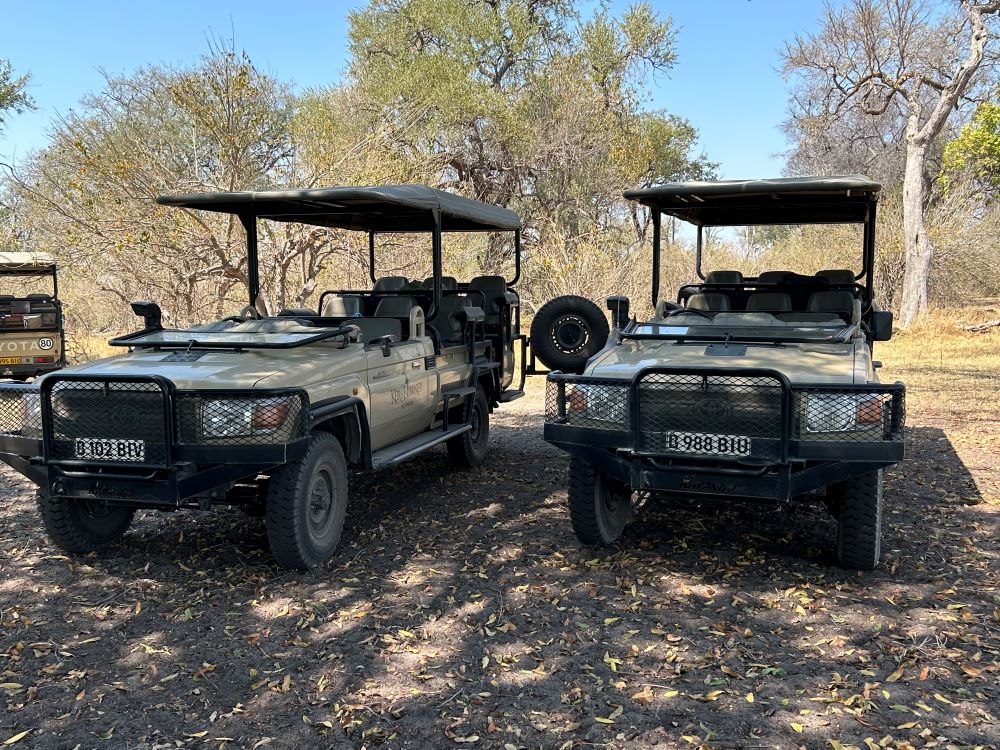
The elephant padded implacably towards us on the dirt road. Rafael, our guide, put his finger against his lips, the “Shhh” understood. Our Toyota Land Cruiser, engine running, sat in the middle of the dusty trail. The four paying cargo made a collective gulp, mouths dry. Our hands, normally quick to grab for the cell phone and take a picture, stayed at our sides. The elephant loomed like a three-masted ship of the line, silent and grey, sails full, bearing down on our dingy. Rafael slipped into reverse, and we lurched back several feet. No good. I pictured my daughter at age five tipping over her Fisher-Price school bus and watching all the Little People tumble out, scattered on the kitchen floor.
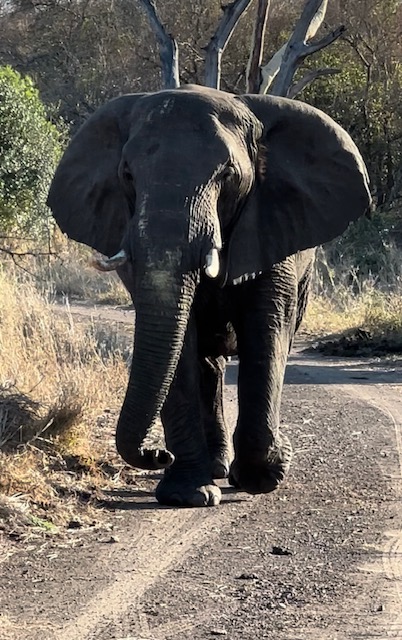
The big ellie had a decision to make: (a) shove the Land Cruiser out of the way and continue along the soft dirt road or (b) detour around it into the less comfy scrub. He was late for a scheduled herd meeting and toppling the Cruiser and its contents would require time and effort. He opted for plan (b). I looked up as he passed, eight feet away. His right eye regarded us for a long second, improbably long eyelashes batting. Was that a scowl?
In the Galapagos, My Life’s Editor and I watched fauna that ignored us. We brushed past blue-footed boobies as they fed their young. We stepped over snoozing iguanas and sea lions. The explanation for their lack of interest in us was that they were naïve, innocent. Nothing has happened in their lifetime to warrant fear. We were wallpaper in the room.
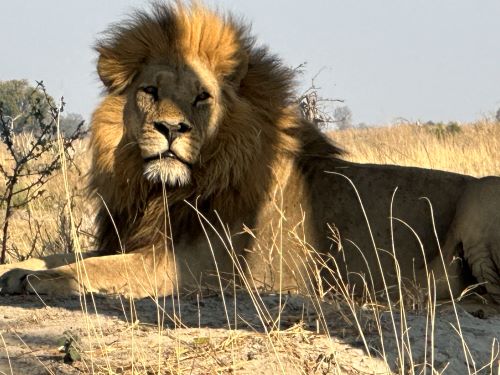
Most African mammals, in contrast, have endured the human act for eons and are not impressed. They are not naïve. They acknowledge safari folk, but expect them to keep their distance. Cape buffaloes hunkering in the mud, rhinos grazing in the scrub, and lions sunning in the savannah did not take much note of us. I am accustomed to indifference. An aging, bald, white male of Scots Irish extraction, given to wearing comfortable shoes, I am used to being considered part of the scenery.
The animals we watched from the seats of the Cruiser did not see me, My Life’s Editor, and my sister-in-law. They saw a truck, a noisy, non-animal object that is part of the African landscape. Starting at sunrise, trucks intruded on the critters’ lives. From the truck, we were voyeurs of an animal’s daily life, trailing them, watching them in their kitchen, their rec room, and at times, their bedroom.
Zebras and antelopes, daily fare on the carnivore menu, were less casual about our attention than the big guys were – elephants, Cape buffaloes, and lions. Zebras and antelopes set a virtual perimeter around their grazing area. If we pierced the perimeter with the truck, they became edgy and, one by one, made themselves scarce. Their mantra was Ronald Reagan’s toward Russia: Trust but verify. Warthogs immediately turned tail and fled upon sighting our truck. They have good reason to scram – they are the pulled pork sandwich of the savannah.
The business model of a pride of lions requires successful execution of three lines of activity: hunting and eating; sleeping and lolling about; and lastly, reproducing. There are no committee meetings, unless you include the family-style picnic dinners. The chairman of the board, the dominant male, takes care of the last line of activity. Young males do attempt takeovers, wanting to get in on the action when the big kahuna has stepped away for a moment. We learned that lionesses prefer males with heavy, dark manes, are not as impressed by blond-maned dudes. Were I a lion, I would be out of luck, as I am mane-less.
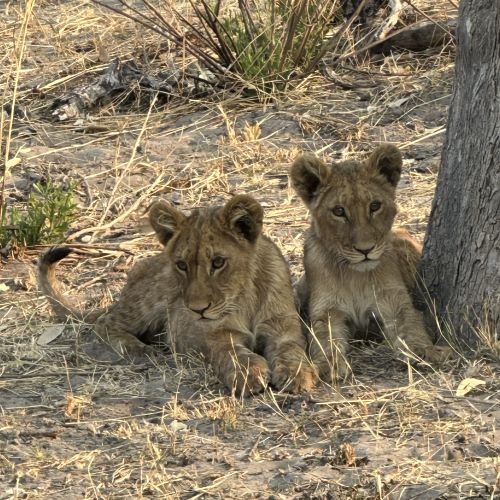
The Equal Rights Amendment does not apply to the lion pride. Lionesses do the bulk of the hunting and catching, the chairman saunters up only if heavy lifting is required, taking down bigger prey. On a late evening drive in the Cruiser, we came upon two lion cubs clumped in the shadow of an acacia tree. The cubs shivered, seemed weak. Rafael, our guide, turned to us with a grimace and said there had been four cubs the day before. A leopard had altered the count. Mom was not about. She was hunting dinner, a matter of survival for the two remaining.
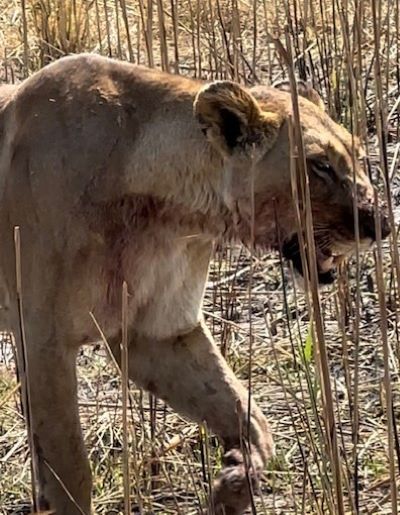
The next day we came upon the mother lioness and stopped. She walked past the stilled Cruiser, heading for the cubs’ location. Her muzzle and chest were splashed with blood. We found her kill, a kudu. She had devoured the choice organs, rich in protein. Later that night our headlights lit up the cubs and the lioness feeding on the kudu. The pride had stayed away, granting her kill-rights. The next day the lion pride came for its fill, leaving only bones scattered in the dirt.
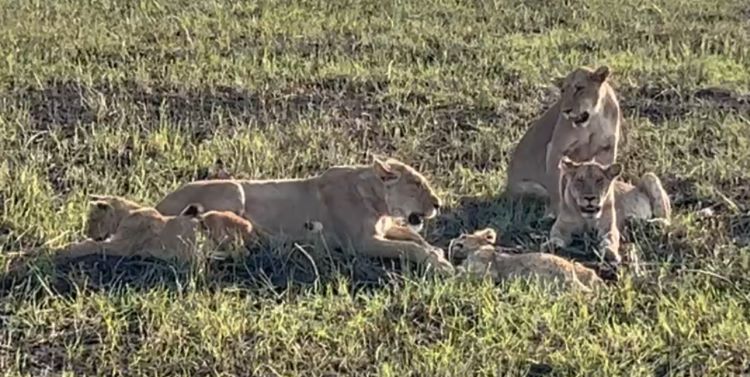
We came upon the pride as they rested after their banquet. We turned off the motor and sat quietly. Cubs lazily pawed at each other. There was no sound, save the wind on the savannah. We felt reverent, far removed from the noise of society – 24-hour news cycles, narcissistic politicians, and mass shootings.
Silence in our day seems quaint, an artifact of earlier times. We should not have to go to Africa to find it.
 Marshall Craig
Marshall: As always, your essay was full of memorable phrases that display your ironic sense of humor in a very special way. Lines interspersed with the main story â e.g. âI am accustomed to indifference.â Perfect.
The trip was obviously full of magical moments and I am pleased that you shared them with me. My only trip to Africa was a 5 day trek across the Sarah Desert accompanied by visits to the market town nearby. Pristine wilderness meets chaotic activity. No animals, save distant camels, in sight.
Continue to enjoy the humor in your posts and look forward to those that will surely follow.
Tom
LikeLike