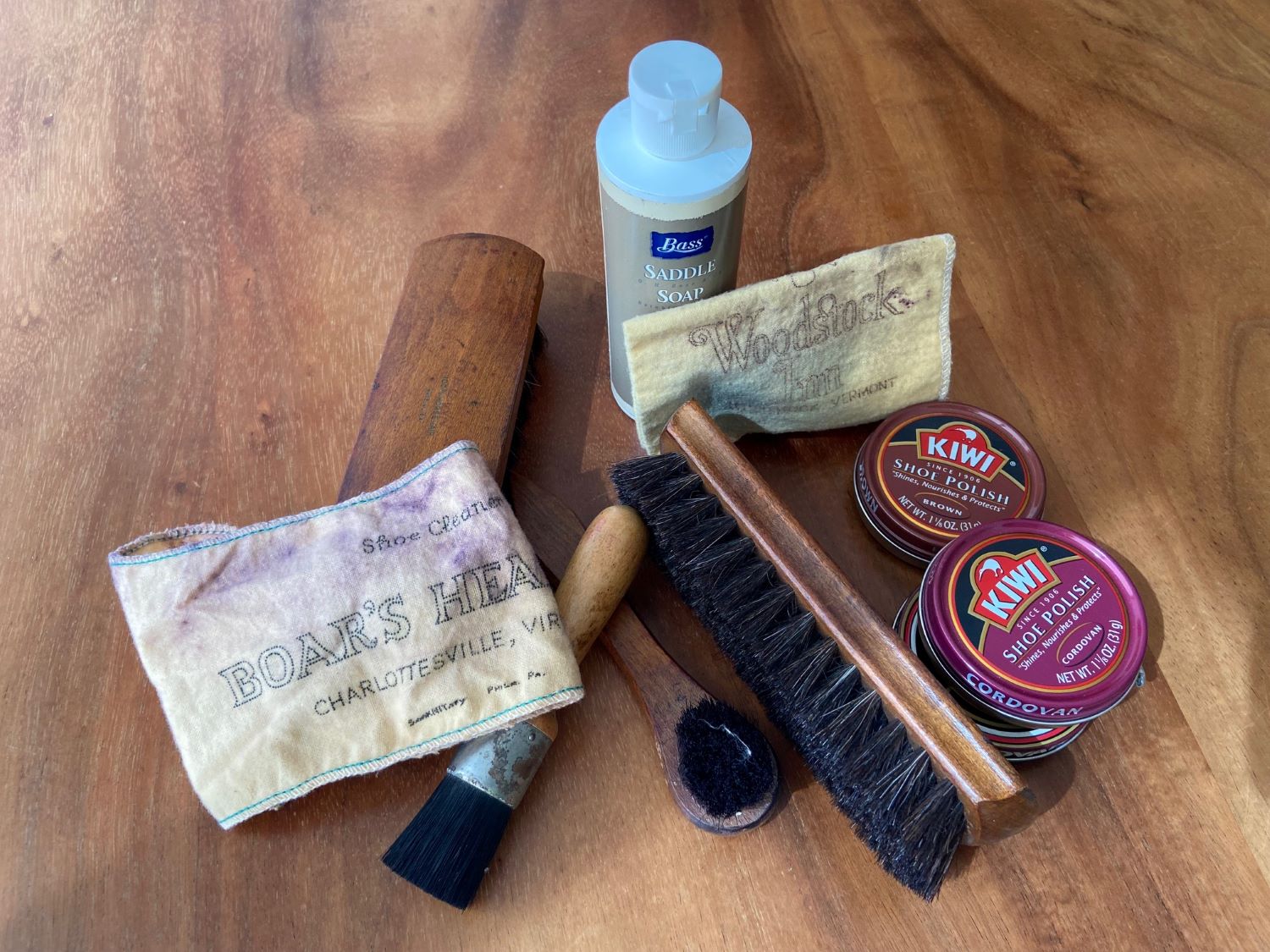
In the year 2300, two archaeologists will dig on the site of what was formerly the town dump of St Petersburg. At the Post-Trumpian time stratum, among discarded diapers, political campaign flyers, and empty Kombucha bottles, they will find an open wooden box. “What are these?” the junior one will say, prodding at objects in the box. “Remarkable,” will say his companion, a veteran of many digs. “These are rare even for that time. These were used to produce a sheen on the surface of foot coverings made of processed animal skin, called leather.”
In my shoeshine box, they will find: two shine brushes (brown, black); two polish brushes (ditto); three cans of polish (cordovan, brown, black); a bottle of saddle soap; and three shine cloths (one filched from the Woodstock Inn in Vermont and one from the Boar’s Head Inn in Charlottesville, VA). I come from a military family. Shined shoes were as integral to daily life as a straight gig line and the spoonful of cod liver oil my mother administered before we were off to grade school. My father would sit on a chair with his shoeshine box in front of him. It was sturdy with four peg feet, a locking lid, and a form on the lid for securing a shoe for buffing. He would apply polish, then grit his teeth and saw back and forth, first with a brush and then with a cloth to bring out the shine. He wore black plain-toe shoes with his green service uniform or brown British walkers for civvy dress.
Shoeshines were not in my job description in my early teens, think dirty bucks, white bucks, and Converse sneakers. But the summer I worked for Specialist Fifth Class Jim Washington at the Officers’ Open Mess snack bar, I learned how to spit-shine combat boots as well as grill burgers and screen phone calls to keep Jim’s girlfriend separate from his wife. Jim applied black polish and set it aflame with his lighter, creating a slick uniform coat across the boot toe. Once the polish was dried, he rubbed a cotton T-shirt daubed in water in small circles with his finger. Every so often he would tip the boot toe up to the light to appraise the gleaming surface.
In college a pair of abused loafers sufficed for me, duct tape wrapped around the toe to secure a flapping sole. Polishing them would have been applying lipstick to a pig. The nearest shiny shoes in New Haven would have been at Albertus Magnus College for women. It was rumored Aggie Maggie women were warned their freshman year against wearing patent leather shoes, for fear the reflections from them would excite libidinous Yalies. In those all-male days, the mere sighting of a female graduate student at Sterling Memorial Library caused a disturbance in the Force.
I was re-acquainted with shoe polish when I manned a desk in the American National Bank of Chicago’s commercial lending division. The measure of a junior bank officer was the cut of his suit, the whiteness of his button-down, the blahness of his tie and the shine on his shoes. Attending a dinner party at a peer’s home, I peeked inside his clothes closet and counted 10 laundered and starched white shirts, each hung an inch apart. Terrifying. I wore garters to hold up over-the-calf socks, as my father had done. They cut off blood flow to my knee, but no fish-belly white shin flashed when I crossed my legs.
The ground floor of the ANB building was a concourse, home to a café, a sundries store, and an elevated shoeshine stand. Two gentlemen wearing blue cotton jackets over collared shirts manned two wooden armchairs. When not engaged, they sat in the chairs and read the Chicago Daily News, studied box scores, and bemoaned the latest White Sox debacle. They smoked, tipping their ashes into the top lid of a shoe polish can. At the arrival of a customer, the one next up to bat would wave a hand to proffer his chair. He would flap a shine cloth at it to remove any foreign materials that might sully the customer’s trousers. Up in that chair I would be king, above the hurly-burly of commoners crossing below my throne on their mundane affairs. Just like in the Chattanooga Shoeshine Boy song, the men flashed their trade: “It’s a wonder that the rag don’t tear; the way he makes it pop.” When the shine man was done, he would tap me on the toe of my shoe. I would stand, fish out three bills and stride away, my father for a day.
 Marshall Craig
Marsh,
Best yet – thanks.
Nick
LikeLike
I haven’t shined a shoe in ten plus years. I’ve got shoes older than my last shine.
LikeLike