For decades, our household had two tenants hanging around rent free: Sarah, my great-great grandmother, and her grandmother, Elizabeth. Sarah and Elizabeth lived in a portrait painted in the 1830s. In the portrait, Elizabeth Gilmer is aged and courtly. She looks sternly at the passer-by. Dignity was valued in her time. Rampant narcissism – selfies, Family Feud, and TikTok – lay 200 years in the future. She holds Sarah Bibb gingerly in her lap. Sarah is the ideal child: pink-cheeked, plump, and self- satisfied. She looks off, avoiding her grandmother’s eyes. Maybe she did something to warrant her grandmother’s pinched nose? Maybe she is not so ideal.
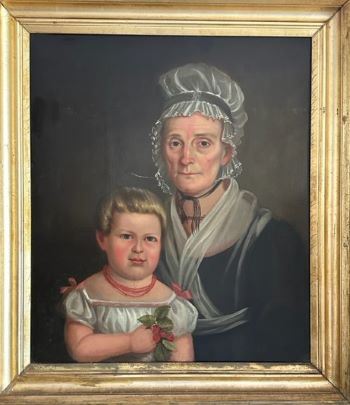
My Life’s Editor was never enthusiastic about Sarah and Elizabeth. Elizabeth’s glum face said “Thou shalt not be having any fun.” The portrait hung in the dining room, suitable for formal occasions. Dinner guests foraging on their salads averted their eyes from the two. Our children avoided walking through the room, saying that Sarah’s and Elizabeth’s eyes followed them.
Granddaughter and grandmother’s painting resided at our house for decades because it was a family heirloom. Unlike an heirloom tomato, which can be eaten, these are objects that well-meaning parents leave with their children because their parents left the objects with them. Pieces of heavy furniture, mantle clocks, and grandpa’s shooting trophy lurk in households because of guilt.
Sarah and Elizabeth are under the cloud of history’s judgment, wherever their portrait hangs. They were part of the Bibb family of Montgomery. Two Bibb brothers, William Wyatt and Thomas, were the first and second governors of Alabama, respectively. Sarah’s father, Benjah Bibb, a third brother, was an ardent supporter of the Confederacy. He owned 125 slaves and thousands of acres at the peak of his prosperity. Because he had never sought or received office in the Confederacy, he received a pardon from President Andrew Johnson on August 19, 1865.
When My Life’s Editor and I surrendered to the siren call of a downtown condo, we parted with roomfuls of upholstered and wooden furniture. Our new digs gleamed with glass, granite, and swiveling leather chairs that could pitch an unwary guest onto the floor. Sarah and Elizabeth didn’t fit with the vibe. Our children, sensible people born in the ‘70s, not tethered to the past, did not clamor to hang ancestors on their walls. Sarah and Elizabeth went into the air-conditioned condo storage room along with suitcases, tax files, Igloo coolers and the like. They kept good company, though, secure in an artistic comfort zone between My Life’s Editor’s unhung paintings and unused canvasses.
Late at night I heard their plaintive voices. “Maarshaall …” they’d coo in a duet. “Remember us, your family? Why have you forsaken us?” I was riven by guilt.
Rummaging among family documents, I found a letter from a curator of the Alabama Department of Archives and History. He said their archives held portraits of Benjah Bibb and his wife, Sophie. Sarah was their daughter; Elizabeth was Sophie’s mother. Eureka! What if I donated my portrait, reuniting the family in archival bliss? I emailed a query, attaching a photo. The folks at Archives and History responded with interest. They allowed they would take a look at the portrait, acceptance provisional. They were concerned about its condition. Nearly 200 years might have taken a toll on the two. Did the painting have tears or water damage from rowdy Craig parties? Had it been touched up to give Elizabeth a less melancholy look?
We wrapped the portrait in swaddling clothes and delivered it on a Friday afternoon to the Archives and History building in Montgomery. The edifice is striking, a monumental white marble structure resplendent in Ionic columns. Alabamians take both their history and their historical digs seriously.
MaryTaylor and Ryan of the Department of Archives and History greeted us warmly at the visitors’ entrance and swept us into the innards of the building. We felt important. Below ground level, we entered a chilly archives room, the walls lined with paintings and the floor supporting a forest of shelves groaning with memorabilia. We plopped Sarah and Elizabeth down on a broad table, MaryTaylor and Ryan hovering expectantly. Ryan peeled back the wrappings with the care and anticipation of someone opening a Christmas gift. She pointed out ante bellum nuances in fabric and dress. Heads nodded. It looked like the grandmother and granddaughter had found a home.

Ryan gave us a tour of the Alabama History Museum. Grim bits of history were presented with as much grace and clarity as the chest-swelling bits. The Alabamian 1/16th of me was proud. That evening we watched the Tampa Bay Rays’ AA affiliate Montgomery Biscuits sweep the Biloxi Shuckers in a doubleheader. We capped off the victory at Dreamland Bar-B-Que, feasting on combo plates of ribs, BBQ pork and baked beans paired with iced teas the size of thermoses. Delicious.
The sobering coda to our trip was a visit to the National Memorial for Peace and Justice – also called the national lynching memorial – and the Legacy Museum with its tales of slavery. At the museum My Life’s Editor teared up. A sympathetic guard rescued her, offering a tissue packet. I thought of Benjah, Sophie, Sarah, and Elizabeth. Their portraits held them in an antebellum time capsule like a species preserved in amber. They did not know of the coming war, economic disaster, and the stern judgment of history.

 Marshall Craig