“Sounds pretty good,” said my crack guitar teacher, Douglas L. He was zooming me from two feet away, his angular face with soul patch framed in my laptop. I basked in his praise. If I were a dog my tail would have been wagging. It had taken me two months to subdue sixteen bars of “Casey Jones” by Mississippi John Hurt, a famed acoustic blues man born in 1892. Like many in my cohort, four years of college had passed with an acoustic guitar nearby. A folk song was “three chords and the truth.” Those three chords were C, F and G. You could add G7 for variety, maybe Am if you wanted pathos. When I was a pre-teen, my parents thought I should learn a musical instrument. They conducted extensive research to determine the instrument best suited to my talents and hit on the accordion. This was pre-Lawrence Welk, so my future was not assured. My parents theorized that though I might not make it on the Elk Lodge circuit, I could always be the hit of any party, bringing along my 48-base red Hohner. (Oh look, here comes Marshall with his fabulous accordion! I hope he plays ‘‘Lady of Spain.’’) My accordion career crumpled when my high school music teacher directed me elsewhere. Strapping on the accordion was a struggle, what with his wooden leg and all. I wound up playing third trumpet in the school band, blatting out four-beat measures in “Pomp and Circumstance.” I killed quarter notes.
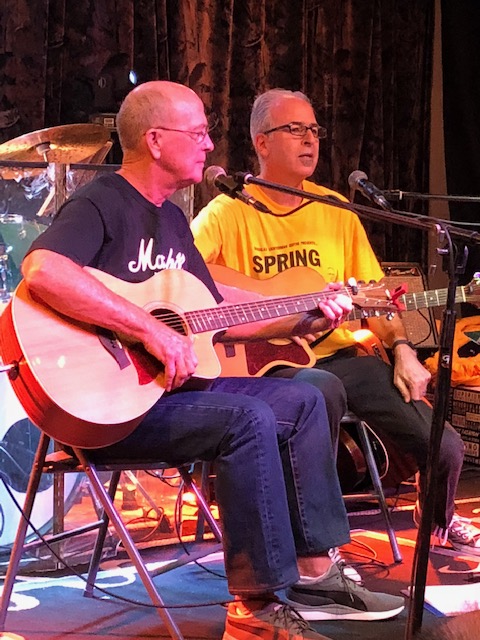
Fast forward to retirement. I brought out the old guitar that My Life’s Editor had bought me some years prior and eyed it speculatively. Could I advance beyond C, F, G and occasionally G7? I purchased a Taylor acoustic guitar and started lessons with the ever-patient Douglas. I entered the world of finger picking, the pentatonic scale and the seven modes. I left “This Land is Your Land” in the rear view mirror. By my sixth year I advanced to the point that I was the seventh guitar player in Douglas’ “Spring Jam” for his students, wedged in between an eight-year old performing the “Stairway to Heaven” guitar riff and a twelve-year old. There was an audience of adoring parents and free hot dogs.
Today I enjoy sitting down of an evening and working on my repertoire at home. I am not ready to set up shop on tony Beach Drive in downtown St. Pete, my guitar case open for folks to flutter in fivers. There is the issue of my producing the same number of beats in each measure I play. My singing is exploratory in nature. I warily approach a musical note from below, grab it for a moment, then slide down the other side. My fingers get an attitude on occasion and sulk. I do take pride in those 16 bars of “Casey Jones.” On the day they came together I was elated. There is magic in challenging yourself whether it be using chopsticks or riding sidesaddle. The more difficult, the better.
Let me introduce Dame Juliana Bernes, a nun, who wrote a Treatyse of fysshynge wyth an Angle in the 15th century. She is to blame for frustrated fly fishermen right up to this century who have shivered in frigid trout streams. A leak in their waders trickles down their leg and a creature with a brain the size of a pencil eraser sneers at their fly. Like playing the blues on a guitar, fly fishing requires skill.
It is difficult to explain to people why a person would fly fish. Fly fishing is not a very productive way to catch fish. Maimonides is thought to have said “Give a Man a Fish, and You Feed Him for a Day. Teach a Man to Fish, and You Feed Him for a Lifetime.” He was not talking about fly fishing.
In casting, the weight of the fly line carries the lure – feathers and a hook – out over the water. Ten feet of clear monofilament connects the fly to the fly line. The magic lies in the flexing of the eight-foot rod and the pull of the heavy fly line, streaming out behind as it loads on the back cast with the cocking of your forearm and then releases as your forearm snaps down, like hammering a nail. The objective is to deliver a fly to the water’s surface as gently as a lover’s kiss. Piece of cake.
There are two places where fly fishing particularly comes into its own. One is where the fish’s diet consists of small, crunchy insects, and the other is where the water is very shallow and the splash of a large lure would cause every fish within a quarter mile to vamoose. It is a benediction on the lives of fly fishermen that these locales are trout streams and Bahamian bonefish flats. Fly fishermen exercise their skill in gobsmackingly beautiful surroundings.
Late one afternoon I was practice casting on the lawn bordering Pioneer Park in downtown St. Pete, careful to avoid stepping in dog poop. A patron of our local saloon, Courigan’s, spotted me and hustled over, crossing the street, careful not to spill his beer. He came up alongside and said “Hey, fly fishing huh? Pretty cool!”
I said, “Yeah, it is cool. Very cool.”

 Marshall Craig